How to ensure effective at-source welding fume extraction using extraction arms for local exhaust ventilation
In many welding applications, at-source extraction is the most effective solution for capturing fumes directly where they are generated. This article explains how extraction arms can be used within local exhaust ventilation (LEV) systems to achieve efficient at-source welding fume extraction, and which factors influence performance in practical use.
By working close to the source, the spread of contaminants within the workspace is reduced, lowering exposure for both operators and the surrounding environment. However, equipment selection alone does not determine the outcome. How the extraction system is positioned and used in daily operations has a significant impact on its overall effectiveness.
How at-source welding fume extraction works in practice
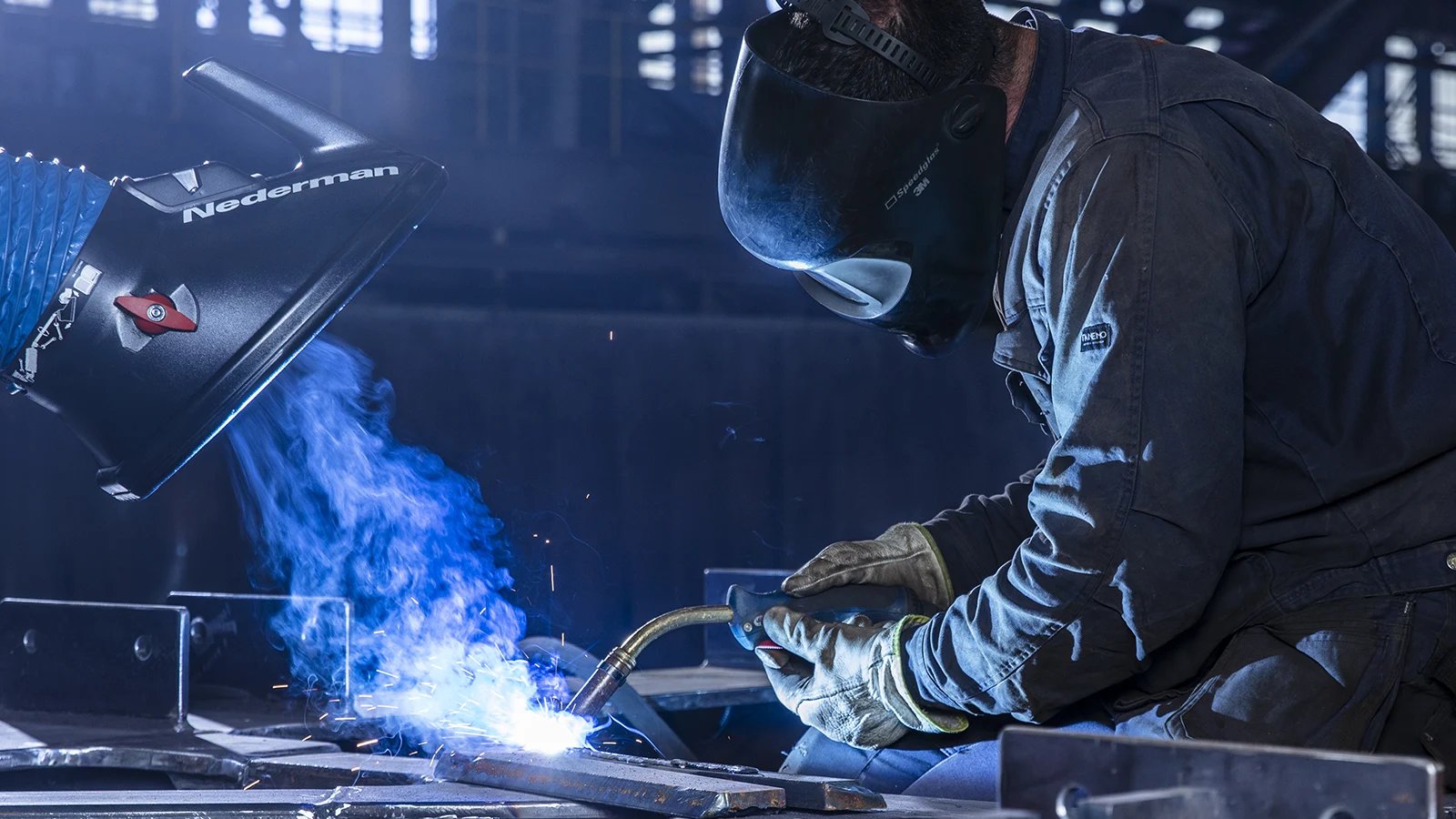
At-source extraction is based on capturing fumes as close to the welding zone as possible before they have time to disperse. In practice, this typically involves positioning an extraction arm close to the arc and adjusting it according to the specific task.
When the extraction unit is correctly positioned, a large proportion of particles is captured immediately. However, if the distance is too great, capture efficiency decreases rapidly, as welding fumes disperse and mix with the surrounding air.
To ensure that any fumes not captured at the source are still effectively managed, at-source extraction is typically integrated into a broader system for welding fume control in production environments, where multiple solutions are often used together.
Extraction arms as a solution for at-source welding fume extraction
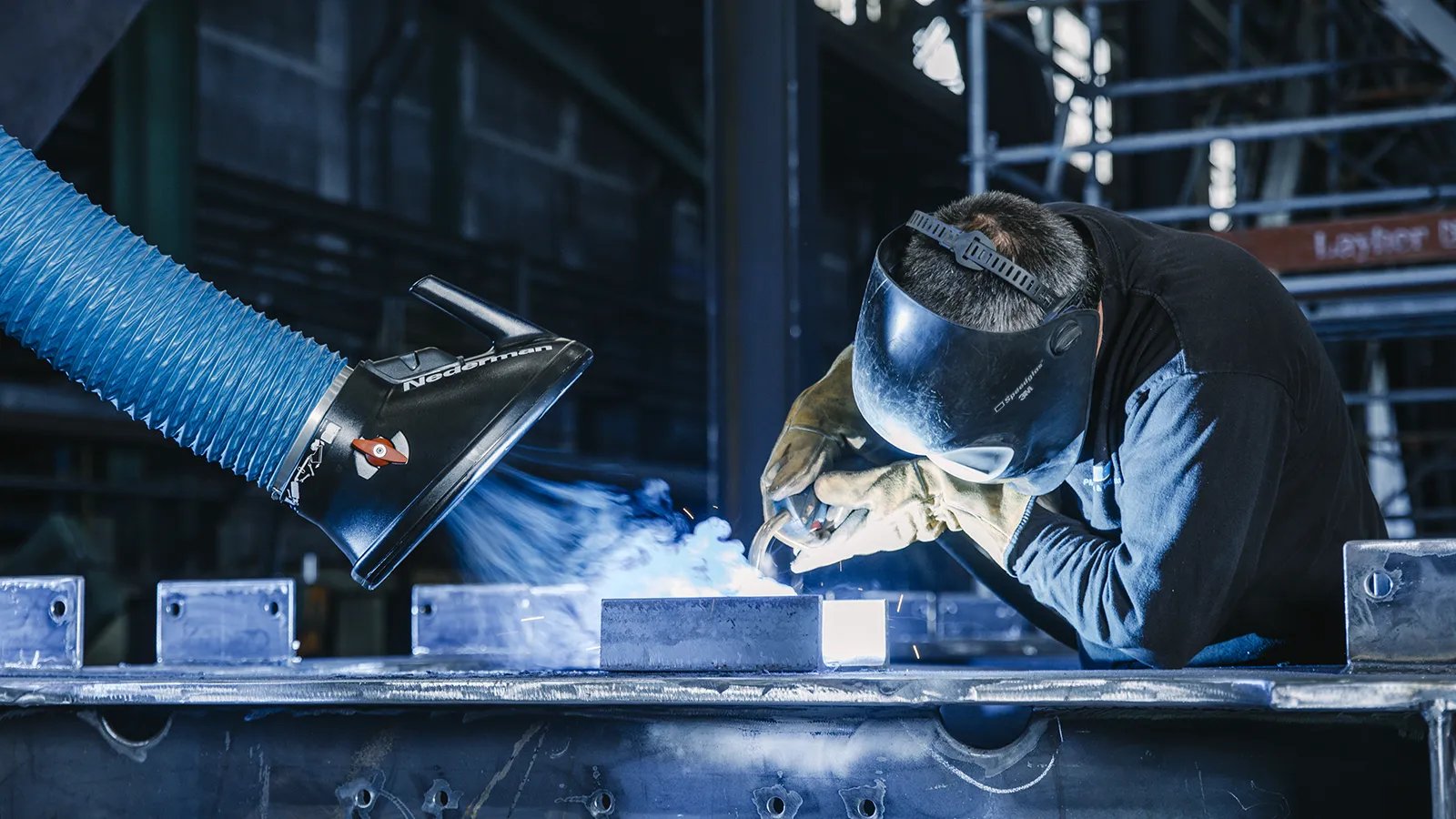
Extraction arms are a common solution for at-source extraction in welding, as they can be positioned exactly where needed. They are designed to be flexible and adjustable in multiple directions, allowing them to follow the work process without interfering with the operator.
To be effective in practice, the extraction arm must be stable in position and easy to handle. If it is perceived as heavy or difficult to adjust, there is a risk that it will not be used consistently, which reduces the overall effectiveness of the local exhaust ventilation.
Adequate airflow is essential to extract welding fumes, and the extraction hood must be positioned close to, and directed towards the welding zone to capture fumes before they disperse.
The importance of correctly positioning extraction arms for effective at-source welding fume extraction
The positioning of the extraction arm is critical to the outcome. A common mistake is to position the extraction system too far from the welding zone or at the wrong angle in relation to the movement of the fumes.
To ensure effective at-source extraction, the unit must be positioned so that fumes are captured before they pass through the operator’s breathing zone. This often means placing the extraction hood slightly above and to the side of the welding area, rather than directly from above.
Even small adjustments in position can make a significant difference to capture efficiency. For this reason, it is essential that the extraction arm is easy to move and actively used throughout the entire welding process.
At-source extraction as part of a complete welding fume extraction solution
At-source extraction is designed to capture fumes directly at the point of generation and is often a key component in reducing the spread of welding fumes within a facility. In practice, however, there are situations where at-source extraction alone does not provide sufficient performance.
This can occur when welding larger structures where the operator needs to move frequently, in production environments where multiple welding processes are taking place simultaneously, or where processes vary.
In such cases, it can be difficult to maintain optimal positioning at all times, allowing fumes to spread within the workspace before being captured. In these scenarios, at-source extraction must work in combination with other extraction systems, such as on-torch extraction or ambient air filtration systems to manage the surrounding air.
At Nederman, we provide complete system solutions where at-source extraction is integrated into a broader approach. This allows both at-source capture and overall air quality management to be tailored to the specific conditions of just your production.
Take the next step and find the right extraction solution for your operation
At-source extraction is the most effective solution for capturing fumes directly where they are generated and is widely used across a broad range of applications. Whether used as a standalone solution or integrated with other welding fume extraction systems, our clean air experts will help you design an optimised solution to extract the fumes at the source, tailored to how your operations work in practice. Contact your local Nederman team today!